

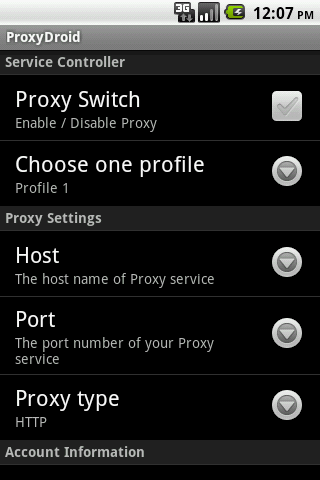
ProxyDroid for Android solves a problem that every power user knows all too well: most apps completely ignore your system proxy settings. That means you cannot route app traffic via your server. Similarly, you cannot bypass a restrictive network without a full VPN.
The open source Android networking tools project gives you granular, profile-based proxy control that works when the built-in Android settings don’t. You’ll be able to (Not open for strategic account selling) connect using the protocols HTTP, HTTPS, SOCKS4, SOCKS5, basic, NTLM, and NTLMv2. This will help you connect to your own proprietary proxy infrastructures, or corporate proxy infrastructures. The app configures HTTP HTTPS proxy with various profiles saved, automatic switching based on Wi-Fi SSID or mobile network type, and home screen widgets for toggling in one click.
Under-the-hood tricks you missed.
ProxyDroid’s core is written in native C, not Java. In simpler words, the whole proxy daemon executes like a compiled binary rather than an Android app process. As a result, we obtain minimal battery drain and low memory usage even when active 24/7. Many users report that the app does not affect device performance at all. This is different from VPN clients which are heavy on the device and consume battery due to the encryption overhead.
The app has a DNS proxy mode for use when behind firewalls that stop DNS resolution to external DNS servers. By agent enablement, the DNS queries are routed through the proxy tunnel itself to resolve the unreachable domains. This feature does include some primitive PAC file support. This is labelled as limited since it will allow you to use simple rules only. It will not let you use enterprise-grade complex scripts.
Per-app routing: Only route needed apps.
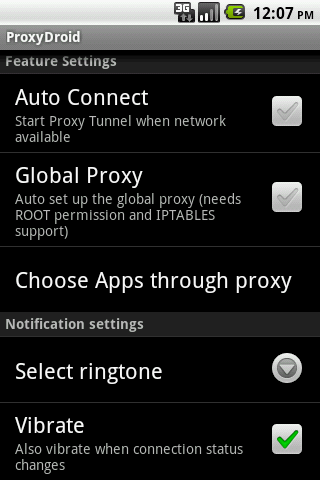
With ProxyDroid, you can apply proxy rules on a per-app basis instead of shoving all device traffic through one pipe. Choose just your browser, email programme or chat programme that you wish to route through the SOCKS5 proxy Android server, while everything else connects directly. By not proxying the ports used by most video games and popular streaming services, latency is minimized while maintaining privacy and anonymity on mobile data for this app.
Connecting to a certain Wi-Fi network makes the work proxy toggle on automatically. After switching off the Wi-Fi and connecting to your home Wi-Fi, the work proxy toggles off automatically.
Force proxies on apps that ignore system.
The prime feature for a rooted Android proxy app is transparent proxying. Due to hardcoded settings, some messaging and gaming apps do not use the global proxy. If you have root access, ProxyDroid can stop and redirect your connection at the system level, which means that every app will follow your proxy rules. This functionality as a transparent proxy for all applications has kept the app popular with developers and network administrators for years.
If you don’t have root, you can only run apps that respect system settings. This can be useful, but far less powerful than having root.
5 Hidden Pro Tips.
- Add ranges with IPs of your local network to bypass the proxy for all traffic coming from them and thus, your internal services will not get proxied.
- Windows proxies can have NTLM auth so that users can authenticate against their domain proxy without needing any third-party application.
- You can create multiple home-screen widget shortcuts that switch between proxy profiles quickly.
- When using custom resolver along with proxy mode to mitigate ISP-level censorship issues.
- The native binary consumes less memory than any Java-based proxy manager, leaving more room for your applications.
ProxyDroid offers a free, open-source solution that provides fast, low overhead proxy control for Android. Per-app routing with automatic profile switching, DNS proxy mode, and root level forcing are the standout features of our top pick for technically confident users. Get it right away and regain control of your device connections with this powerful piece of open-source Android networking tools.







No comments yet :(